October 2026
Energy
Libya
New gas recovery project at Bouri field strengthens efforts to curb flaring and meet domestic energy demand.
Libya accelerates its gas recovery drive
Mellitah Oil & Gas, a joint venture between Eni and Libya’s National Oil Corporation (NOC), has completed the Bouri Gas Utilization Project, an offshore facility designed to recover associated gas previously flared at the Bouri oil field. The project is expected to deliver approximately 24.7 billion cubic feet (bcf) of gas annually for domestic consumption and export through the Greenstream pipeline to Europe, while reducing greenhouse gas emissions by around 1.5 million tonnes of CO₂-equivalent annually.
The project comes as Libya continues to grapple with significant volumes of natural gas flaring. In 2025, Libya flared approximately 335 bcf of natural gas, equivalent to around 37% of its total gas production in the same year. The General Electricity Company of Libya (GECOL) operates about 7.98 GW of installed, gas-fired power generation capacity which requires about 1.85 bcf/day assuming open-cycle gas turbines – almost double the country’s entire production in 2025. The continuous flaring of gas further widens this gap and this is what makes projects like Bouri important. At its expected annual capacity, the Bouri project could deliver approximately 7.4% of the volume flared in 2025, and help ease pressure on the domestic gas markets.
The Bouri project also forms part of the NOC’s wider programme to reduce gas flaring by 60% by the end of 2030. In January 2026, the NOC reported that projects across several operating companies had reduced flaring by more than 100 million cubic feet per day, with a further reduction of 120 million cubic feet per day targeted for 2026. The Bouri project brings the NOC to an estimated 67.7 million cubic feet per day closer to its target. Additional efforts include gas recovery project at the Intisar A/103 gas pipeline, which entered trial operation in April 2026 and is expected to recover approximately 150 million cubic feet of previously flared gas daily.
Source: Eni completes gas recovery project at Bouri Field
Figure 1: Libya’s flare gas volume, 2005 – 2025
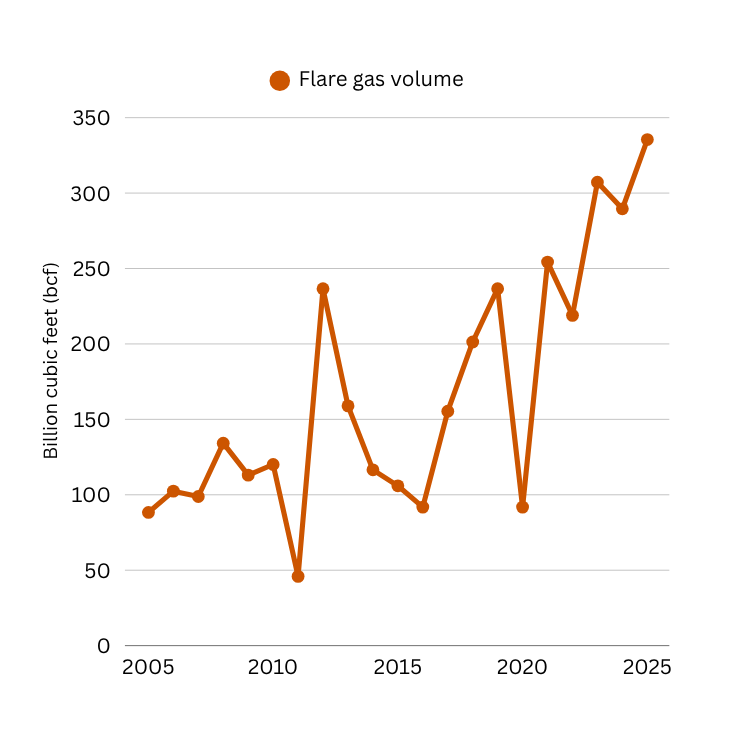
Source: Energy Institute
Agriculture
Namibia
The European Union suspends meat import from Namibia.
What is happening…
In February, we reported that Namibia was the only country bordering South Africa that had not reported a foot-and-mouth disease (FMD) outbreak. That has since changed. Following its September outbreak, Namibia has joined other affected Southern African countries, including South Africa, Botswana, Zimbabwe, Zambia, Eswatini, Lesotho, and Mozambique.
Namibia’s first confirmed outbreak was recorded on 23 September 2026, when laboratory tests returned positive results in 10 of 11 cattle samples collected from a commercial farm in the //Kharas Region. This marked the first detection of FMD in the country’s southern livestock zone, and unlike the disease-prone northern zone, had remained free of FMD since the 1960s. The southern zone, which lies south of Namibia’s Veterinary Cordon Fence and covers its central and southern commercial farming areas, has maintained its World Organisation for Animal Health (WOAH)-recognised FMD-free status without vaccination since 1997. Following the outbreak, this status was suspended, threatening Namibia’s access to lucrative international meat markets.
The situation became more concerning in October when a second outbreak was confirmed on Kalala Island in the Zambezi Region, in northeastern Namibia. Within weeks of the initial detection, the outbreak in the south had affected 18 farms, with 131 animals testing positive.
The greatest immediate concern, however, is the impact on Namibia’s meat export industry. The suspension of the southern zone’s disease-free status prompted the European Union, Namibia’s biggest market for beef exports, to suspend imports of fresh beef, sheep and goat meat, as well as biltong and jerky, from the affected export zone. This represents a significant setback for an industry that generated over N$2.1 billion (approximately $127 million) in beef export earnings in 2025, with the EU accounting for 81% of total exports.
The economic implications extend beyond lost access to export markets. Nationwide restrictions on the movement, marketing, slaughter and trade of cloven-hoofed animals and their products have disrupted the domestic livestock supply chain, making it more difficult for farmers to sell their animals and affecting the operations of abattoirs, livestock traders and other businesses that depend on the sector. The Namibia Agricultural Union (NAU) estimates that prolonged disruption could result in approximately N$2.4 billion in cash losses across the livestock value chain over six months, equivalent to about N$13 million daily.
Source: The EU suspends meat imports from Namibia
Mining
Liberia
Liberia launches the Formalization of Artisanal and Small-Scale Mining for Peace and Security (FASMIN) initiative.
What this means…
This initiative is aimed at bringing more artisanal and small-scale miners into the formal economy, curbing illegal mining and increasing government revenue from mineral resources. The project, funded by a $2 million grant by the African Development Bank (AfDB), is being implemented jointly by Liberia and neighboring Sierra Leone, with each country receiving $1 million to strengthen oversight and formalize its artisanal mining sector.
The initiative could have significant implications for Liberia’s mining industry, where artisanal and small-scale mining (ASM) remains an important source of rural employment but is largely informal. For instance, ASM accounts for over 50% of Liberia’s total gold production. However, between 70-90% of gold produced is undeclared. The minister of mines and energy, Matenokay Tingban, estimates that the country is losing as much as $1.6 billion worth of gold due to illegal smuggling and the bypass of formal export channels.
By increasing licensed operators from 300 to 500, establishing 15 mining cooperatives and training 500 miners and 150 regulatory personnel by 2028, the government hopes to improve oversight and integrate more production into regulated supply chains. Beyond revenue collection, organizing miners into cooperatives could improve their access to financing, equipment and formal mineral buyers, potentially increasing productivity and improving the quality of mining operations.
Leave a Reply