September 2026
Energy
East Africa and Dangote
Kenya, Ethiopia and Djibouti strike major energy deals with Dangote Group.
One African group, three countries, and a shared bet on fuel security.
What’s happening?
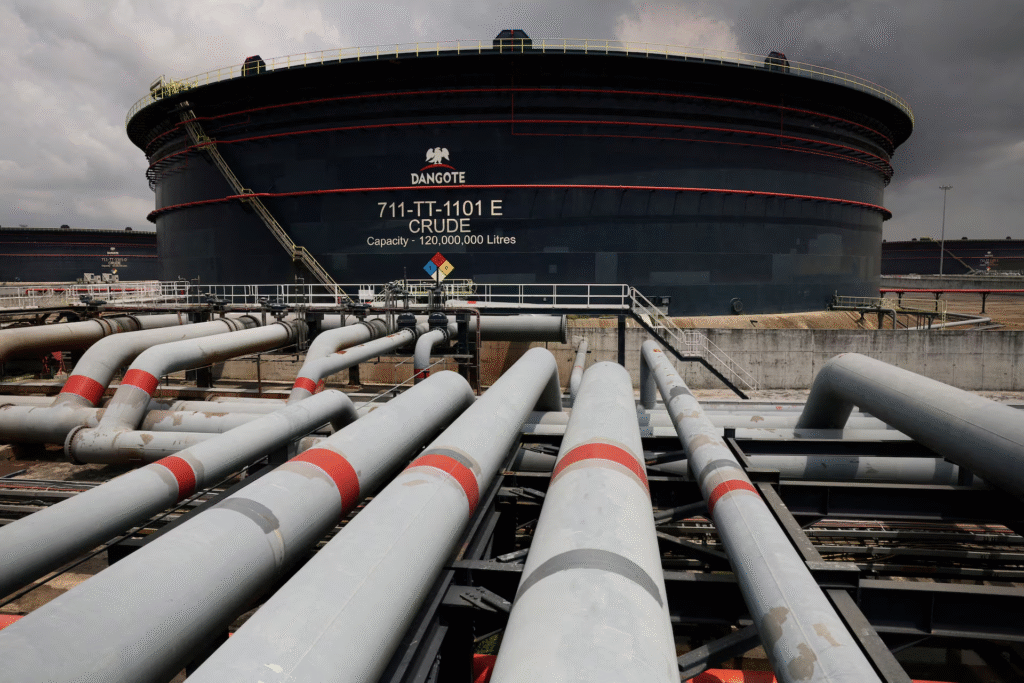
Having transformed Nigeria’s fuel market, Aliko Dangote has turned his attention east. On September 30, he and Kenya’s President William Ruto broke ground on a $16 billion oil refinery and petrochemical complex in Lamu, on Kenya’s coast. When it is completed, targeted for 2030, it will process 700,000 barrels of crude a day. That would make it East Africa’s largest refinery.
To win regional support, Dangote has offered East African governments a combined 30% stake in the refinery. Kenya is considering taking 10%, worth about $500 million. He has also brought back US firm Honeywell, which worked on his refinery in Nigeria. Honeywell says reusing those designs could cut almost two years off construction.
The project has met resistance almost from day one. A group of 133 residents of Chandavai in Lamu went to court, claiming the land is their ancestral home. The court ordered that nothing change on the site until a hearing on October 14. Days after the groundbreaking, the Consumers Federation of Kenya (COFEK) petitioned the Public Private Partnerships Petition Committee, asking for details of Kenya’s proposed stake, including how it was valued and who will pay for it. Environmental groups have also raised concerns about Lamu Old Town, a UNESCO World Heritage site nearby.
Where will the oil come from?
This is the big question, because Kenya does not produce oil commercially yet. Tullow Oil discovered about 560 million barrels in the South Lokichar Basin in Turkana County in 2012, but the project stalled for more than a decade. In 2025, Kenyan company Gulf Energy bought Tullow’s stake, and the government now targets first oil by December 2026. The timing looks neat, but the numbers do not match. Turkana is expected to start at 20,000 barrels a day and grow to 50,000, less than a tenth of what the refinery needs.
Uganda is the other regional hope. Its Tilenga and Kingfisher fields are expected to produce about 230,000 barrels a day combined, with first oil targeted for the second half of 2026, after slipping from 2018, 2020 and 2025. As of June, Tilenga was 74% complete and Kingfisher 79%, so the oil should be flowing well before Lamu’s planned 2030 start. The catch is that Uganda’s crude is meant to flow through the East African Crude Oil Pipeline to Tanzania’s port of Tanga, and Uganda and Tanzania have announced their own rival $20 billion refinery there. There is no pipeline from Uganda to Lamu, so Ugandan crude reaching the Kenyan refinery is far from certain.
That means that, at least at first, most of Lamu’s crude will have to be shipped in from the Middle East, the US and elsewhere. So, the refinery will not end East Africa’s dependence on imports. It will replace one kind of import with another. Still, it’s a step in the right direction. Importing crude is generally cheaper than importing finished fuel, because buyers of refined products also pay for the refiner’s margin. By refining at home, the region keeps that margin, along with the jobs and industry around it, and gains more control over its own fuel supply.
Ethiopia and Djibouti: a pipeline to fix a bottleneck
Further north, Dangote is helping fund a $660 million fuel pipeline between Ethiopia and Djibouti, in partnership with Ethiopian Investment Holdings, Ethiopia’s sovereign wealth fund. The 120km pipeline will link Djibouti’s Damerjog port to a distribution hub in Dewele, Ethiopia, with large storage facilities at both ends. It should begin operating within 18 months.
The problem it solves is simple. Ethiopia is landlocked, so about 95% of its imports pass through Djibouti’s ports. Neither country produces crude oil or has a refinery, so Ethiopia buys refined fuel abroad, ships it to Djibouti, and relies on thousands of tanker trucks to drive it inland. That road is a bottleneck, and it often leads to fuel shortages. The pipeline will pump fuel straight from the port into Ethiopian storage, cutting delivery time to Addis Ababa from five days to one. Djibouti benefits too, through more port activity, jobs and government revenue.
The bigger picture
Together, these deals show Dangote building a presence across East Africa’s fuel chain: a refinery to make fuel in Kenya, and a pipeline to move fuel into Ethiopia. The two stories are already connected. Ethiopia’s Prime Minister attended the Lamu groundbreaking, and Ethiopia has shown interest in taking a stake. But the road ahead is not smooth. Kenya’s refinery faces court battles and an uncertain crude supply, and Uganda and Tanzania are planning a rival $20 billion refinery at Tanga. One African group and three East African countries are betting on long-term solutions. Whether they pay off depends on how these hurdles are handled.
Source: Kenya and Dangote, Ethiopia, Djibouti and Dangote
Senegal
109 oil and gas blocks offered by Senegal.
Why the aggressive offer?
Ten years ago, Senegal was a hopeful explorer. Today it pumps about 100,000 barrels of oil a day, and it wants to use that new status to attract more investors. Senegal has 113 oil and gas blocks, but only four are under contract. The remaining 109 will be offered to local and foreign investors through a roadshow. Interest came quickly. Less than a week after the announcement, Italy’s Eni signed an agreement to study five offshore blocks. The deal does not give Eni any rights to explore or produce yet only the chance to take a closer look. Eni will pay for technical studies of the blocks, with state oil company Petrosen as its technical partner.
The push is about more than oil money. Senegal still runs mostly on diesel power, and September brought frequent blackouts. The government wants to cut electricity prices by 30% by 2030 by switching from imported fuel to its own gas, and that means finding more of it.
Senegal has tried this before. In 2020, it offered 12 offshore blocks in its first-ever licensing round, but the timing was terrible. COVID-19 hit, oil prices crashed, and oil companies cut their exploration budgets. Senegal had also just updated its Petroleum Code in 2019, with tougher fiscal terms and stricter local content rules. Even after the deadline was pushed back several times, the round closed without a single partnership.
This time, Senegal has something it did not have in 2020: proof. Woodside began producing at the Sangomar field, first discovered by Cairn Energy in 2014, in June 2024. Output has beaten forecasts ever since, reaching 36.1 million barrels in 2025, about 6 million more than expected. BP also shipped the first LNG cargo from the Greater Tortue Ahmeyim gas project, which Senegal shares with Mauritania, in 2025. For investors, a basin that is already producing is far less risky than one that only shows promise.
The risk is that Senegal has become a tougher partner. It has terminated or revoked several licences, including Nigerian firm Oranto Petroleum’s, saying the company had done little exploration since 2008 and failed to provide required bank guarantees, and it is in a tax dispute with Woodside. Senegal’s message is clear, serious investors are welcome, but idle blocks are no longer allowed. The roadshow will show whether that firmness attracts investors or scares them off.
Source: Senegal 109 oil blocks offer
Libya
Sharara-Zawiya crude oil pipeline second shutdown.
What happened this time?
Ten years ago, Senegal was a hopeful explorer. Today it pumps about 100,000 barrels of oil a day, and it wants to use that new status to attract more in
It’s the second time this year, the pipeline that carries crude from Libya’s largest oil field, El Sharara, to the coast has been forced shut. This time, the cause was not fire but people. On September 21, an armed group linked to the Petroleum Facilities Guard and the Western Military Zone closed valve No. 7 on the Sharara–Zawiya pipeline, reportedly to press financial and job-status demands for guard personnel.
The impact was immediate. With nowhere for the oil to go, pressure built up in the pipeline and Sharara’s output fell sharply. Over five days, the field lost 942,376 barrels of production, worth about $95 million, according to the National Oil Corporation (NOC). With less crude arriving, NOC also had to shut one unit at the Zawiya refinery. The valve was reopened on September 26. No details of a deal were made public, but the reopening came shortly after the UN Support Mission in Libya (UNSMIL) warned that interfering with oil infrastructure could bring international sanctions.
The episode echoes what happened in March, when a fire broke out on the same pipeline on March 17. NOC blamed a leak at a valve, but investigators later found a Russian-made aerial bomb and fragments of a 130mm rocket near the damaged section, raising questions of sabotage that were never answered. Production was rerouted and fully restored by the end of March.
Two shutdowns in six months come at a delicate moment. In February, Libya completed its first licensing round since 2007, bringing back major names like Chevron, Eni and Repsol, the company that operates Sharara itself. Sharara produces about 300,000 to 320,000 barrels a day, roughly a quarter of Libya’s output, through a single pipeline that runs more than 700km across the country, every disruption reminds investors of the security and political risks. As Libya prepares another licensing round before the end of the year, incidents like this could weaken the investor confidence it has only just begun to rebuild.
Source: Sharara second shutdown
Mining
Burkina Faso
Burkina Faso opens its first gold refinery.
The march toward control continues…
On September 28, Burkina Faso cut the ribbon on RAFFINOR-BF, its first state-owned gold refinery, in the capital, Ouagadougou. Construction began in late November 2023, and the plant can now process 164 tonnes of gold a year, with plans to eventually reach 515 tonnes. It costs about $19 million, financed by the state through SONASP, the national precious-metals company that handles gold production, marketing and processing, in partnership with domestic private investors.
The refinery is the latest step in a deliberate, step-by-step strategy. It began in February 2024, when the government suspended export permits for artisanal and semi-mechanised gold and other precious metals. Officials said the goal was to bring order to a sector where large volumes of gold were believed to be leaving the country illegally, with some of the proceeds allegedly funding the armed groups behind the country’s long-running insurgency.
The next step came in July, when, as we reported, the government granted its state-owned miner, SOPAMIB, a permit for the Bouboulou project, which SOPAMIB will build and run entirely on its own. By then it had already taken over two active mines and three exploration permits.
The refinery completes the sequence. First, control the exits. Then own the mines. Now, process the gold at home so that less of its value leaves the country.
Burkina Faso produced 94 tonnes in 2025 making it Africa’s third largest gold producer. At current prices of about $4,136 an ounce, Burkina Faso’s 2025 output of 94 tonnes is worth roughly $13.7 billion. That is equal to almost half of the country’s nominal GDP of 27.63 billion. About 42 tonnes of the country’s gold comes from small, informal miners, and a lot of it has been slipping out illegally. If the refinery helps bring even 10 tonnes a year back into official sales, the country could earn over $1.3 billion more from exports, plus extra taxes.
The refinery is also built bigger than Burkina Faso needs. It can handle 164 tonnes a year, far more than the country produces, which shows the government might want to refine gold for its neighbours too. Achieving this, however, may prove difficult. Mali is building its own refinery, Ivory Coast plans one next year, and countries like Guinea and Ghana are tightening control over their own gold. To win business, Burkina Faso will need to offer fair prices and earn the trust of buyers abroad. In short, the refinery is not about making money from refining. It’s about keeping more of Burkina Faso’s gold, and maybe some of its neighbours’, along with the money it brings, inside the country.
Leave a Reply